What Should a Membership Dashboard Include?
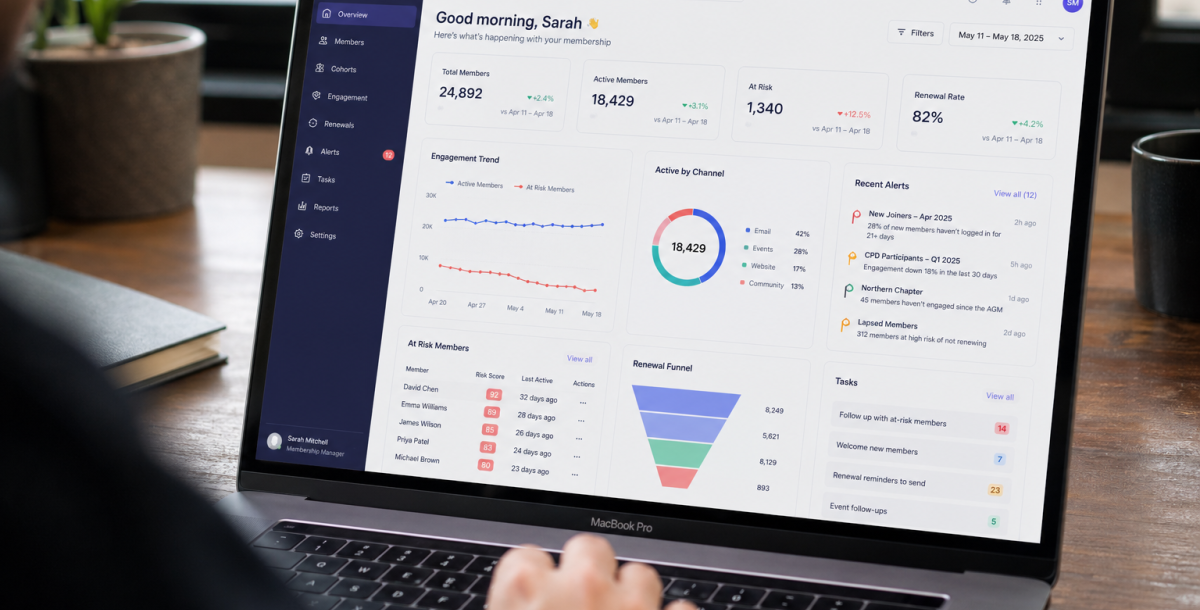
There are two types of membership dashboards I see association membership leaders using:
Archaic. It's a spreadsheet. It's rarely updated, it's awful to look at, and it's hard to work out what's going on.
Something beautiful. Ring graphs for renewal rates. Bar charts for event attendance. A little dial showing engagement score, whatever that means this quarter. They look brilliant in a board pack.
The issue with both is, they tell you almost nothing useful until it's too late.
By the time your renewal chart dips, the members who caused that dip stopped engaging six months ago.
You're really looking at a post-mortem dressed up as a dashboard.
The real job isn't reporting, it's noticing
Nearly half of all lapsed members cite "lack of engagement" as a top reason for not renewing. 51% of associations equate lack of engagement with why members fail to renew.
We've known this for years.
So why do most membership platforms still treat engagement data as something you review in a quarterly report, rather than something the system itself is watching in real time?
The honest answer, I think, is that we built dashboards for the people at the top of the organisation, not for the people doing the work of retention. A CEO wants a trend line. A membership manager wants a name and a phone number.
AI finally lets us serve both, but the interesting opportunity is the second one.
Imagine a membership website that doesn't just log activity but watches for the absence of it. A cohort of 120 members who joined at the same conference last spring, all active for nine months, all quiet for the last three weeks...
The system should tell you, before you lose them.
What anomaly detection actually looks like in practice
It's pattern recognition applied to the data you're already collecting.
Every member platform we build, whether on Laravel or integrated via Stripe, is generating a steady stream of signals:
Login frequency
Forum posts and replies
Event registrations
Email opens and clicks
Resource downloads
Renewal auto-charge attempts
A traditional dashboard averages all of that and shows you a number.
An anomaly-aware system does something different. It learns what normal looks like for each segment, and flags when a segment starts to deviate. Not individuals, cohorts. Because when one person goes quiet, it's life. When fifty people in the same cohort go quiet, it's you.
Microsoft's engineering teams have written about this pattern for years in the context of anomaly detection in time-series data, and the techniques are well-established. What's changed is that the compute cost has collapsed, and the tooling has matured to the point where we can bake it into a member portal without needing a data science team on staff.
You don't need a neural network to notice that 12% of your "new joiners, cohort Q1 2026" haven't logged in for 21 days when the baseline is 4 days.
You need someone to have decided that metric matters, and built the alert.
What to build, and what to stop building
If you're planning a platform migration or a dashboard refresh in the next twelve months, here's what I'd push for.
1) One "quiet cohort" alert before anything else. Pick a segment that matters to you, new joiners, CPD-active members, committee volunteers, and define what "going quiet" means for that group. Then build the alert first. Charts second.
2) Route alerts to humans, not inboxes. A Slack/Teams message to the membership lead with a named list of at-risk members beats a weekly PDF every time. The whole point is to shorten the loop between signal and action.
3) Stop measuring a single "engagement score." Composite scores hide the thing you need to see. A member who has stopped opening emails but is still attending events is telling you something different from a member who has gone completely dark. Preserve the texture.
4) Treat the dashboard as a workflow, not a report. The best member-facing web applications we've built don't just display data. They queue tasks. "These 14 members in the Northern chapter haven't logged in since the AGM. Assign follow-ups?"

The boring truth about AI and retention
I've written before about AI in membership, and the honest summary is that most of the transformative wins aren't glamorous.
It's not a chatbot on your homepage. It's not an AI-generated welcome email.
It's the quiet, unglamorous work of noticing what you couldn't notice manually, because you have 40,000 members and six staff, and no human can watch every cohort in real time.
63% of association professionals believe organisations that don't digitally transform now will not survive long-term. I'd sharpen that. The ones that survive will be the ones whose systems tell them something is wrong while there's still time to fix it.
If you're rethinking your member portal and you want to build something that actually defends your renewal rate rather than just describing it, drop us a line.
We'd love to chat.
More Articles

The Hidden Cost of Poor Member Data
I've sat with enough membership teams to know that data hygiene across the industry is a real issue.

WordPress vs Statamic for Membership Websites
Statamic or WordPress for your membership website? A plain-English comparison covering security, cost, and member experience for non-technical leaders.

Why Statamic for Membership Platform
Why Statamic works brilliantly as a membership platform for large organisations. Flexible, secure, and built on Laravel.