What If Community Was the Strategy, Not Just a Tactic?
Most organisations treat community as a bolt-on.
A Slack channel here. A Facebook group there. A forum buried three clicks deep on the website. Something the marketing team "looks after" when there's time.
And then they wonder why engagement is flat, renewals are sliding, and the members who do show up feel like they're shouting into an empty room.
Here's the thing. Community isn't a tactic. It's not a campaign. It's not a line item on the marketing plan.
It can be the whole strategy.
Kt McBratney said it on our podcast recently, and it stuck with me: "Community can be a solution and it's part of the strategy. It's not a feel-good, nice-to-have for every business. It can be a critical component of business growth directly and indirectly."
Shout it louder for those at the back.
The difference between a tactic and a strategy
A tactic is something you do. A strategy is the reason you do anything at all.
When community is a tactic, it looks like this: you've got a product, a service, or a membership, and community is one of the levers you pull to sell more of it. The community exists to serve the business.
When community is the strategy, the relationship flips. The business exists to serve the community. Every decision, product development, pricing, content, events, operations, gets filtered through one question: does this make the community stronger?
That's a different way of running an organisation. It changes what you measure. It changes who you hire. It changes how you design your membership website and what you expect it to do.
Most membership organisations say they're community-led. Far fewer actually are.
Why the tactic approach quietly fails
I've written before about why communities collapse, and the pattern is usually the same. The business backing the community treats it as a growth hack, members smell it a mile off, and engagement dies.
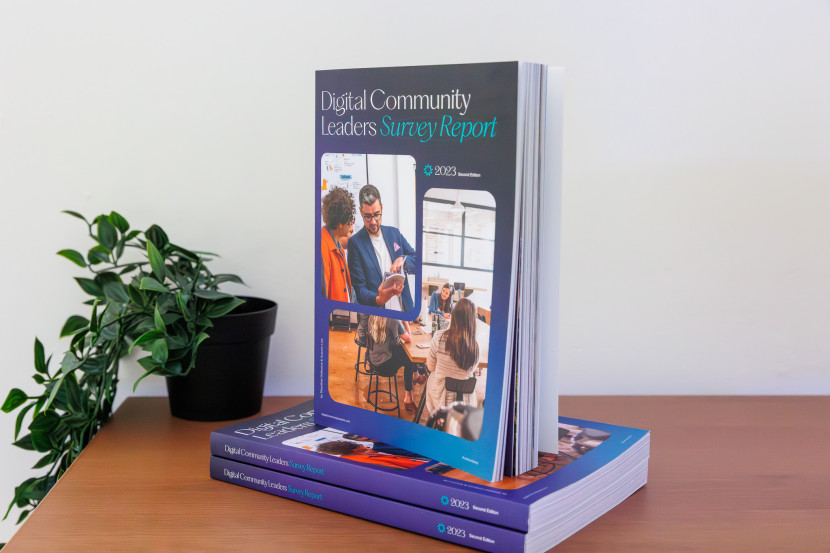
Our Digital Community Leaders Survey showed that growth is the biggest challenge membership organisations face, while online participation is the metric they care about most. Those two things are connected. Growth doesn't come from funnels. It comes from members who feel genuinely valued, who show up, who bring their colleagues.
The numbers back this up. Higher Logic found that 88% of people feel access to an online community improves their member experience, and 60% say they're more loyal to an organisation because of its online community. Meanwhile, 51% of associations say lack of engagement is the top reason members don't renew.
Read those two data points next to each other. Community drives loyalty. Lack of engagement kills renewals. Yet community keeps getting treated as a nice-to-have.
The other failure mode I see constantly: brands building their community "over there" while all the real action is happening elsewhere. A forgotten forum. An abandoned app. A platform nobody logs into because the conversation is already happening on LinkedIn or WhatsApp.
Community shouldn't be siloed. It should be woven into the foundation of how you design the whole business.
What changes when community is the strategy
When you put community at the centre, three things shift.
1) Operations get designed around participation, not transactions. Your systems stop being about collecting dues and start being about enabling connection. That means integrated tools, a single sign-on, event registration that takes thirty seconds, member data that actually follows the member around. We build a lot of this on Laravel because it lets us shape the platform around how the community actually behaves, rather than forcing the community to behave around the platform.
2) You measure different things. Renewal rate matters, but so does participation depth, referral rate, content contribution, peer-to-peer connection. 75% of organisations say member referrals are their most effective acquisition method. That only works when members are engaged enough to advocate. Advocacy is a downstream effect of a strategy that takes community seriously.
3) You stop talking at people. Audiences are passive. Communities are active. A tactic-led approach produces broadcasts. A strategy-led approach produces conversations. The technology has to support that, which is why we keep banging on about community platforms that go beyond a basic CMS and a mailing list. Two-way is the minimum. Multi-directional is the goal.
There's useful thinking on this in the Nielsen Norman Group's work on community UX, which makes the point that participation has to be designed, not assumed.
The technology is not the community
I'll quote Todd Nilson again because he nailed it: "The technology is not the community."
The platform is the building. The walls, the rooms, the corridors. What makes it thrive is the people inside and the purpose that brought them there. You can have the most elegant Laravel application in the world and still have a dead community, if the strategy underneath it is wrong.
But when the strategy is right, technology becomes the accelerant. A well-built learning management system turns members into teachers. A thoughtfully designed member portal turns browsers into contributors. Integrated payments via Stripe Connect turn a community into an economy.
The technology serves the strategy. Never the other way round.
Where to start
If you're running a membership organisation and this is landing uncomfortably, good. Start with questions, not answers.
What does our community exist to do, for the members, not for us?
If we removed the product tomorrow, would the community still have a reason to gather?
Are we designing for participation, or for consumption?
Where are our members actually talking to each other, and is our platform part of that conversation or outside it?
If the honest answer to that last one is "outside it," that's your starting point.
Community-led growth isn't a marketing trend. It's a way of designing a business that lasts. The organisations that get this right in the next five years will be the ones still standing in twenty. The rest will keep wondering why their renewal rates won't budge.
So here's my question for you.
Is community a tactic in your organisation, or is it the strategy?
More Articles
The Hidden Cost of Poor Member Data
I've sat with enough membership teams to know that data hygiene across the industry is a real issue.

WordPress vs Statamic for Membership Websites
Statamic or WordPress for your membership website? A plain-English comparison covering security, cost, and member experience for non-technical leaders.

Why Statamic for Membership Platform
Why Statamic works brilliantly as a membership platform for large organisations. Flexible, secure, and built on Laravel.