Statamic vs WordPress: Why Pick Statamic

WordPress powers about 43% of the web, according to W3Techs. That's a lot of websites. It's also a lot of plugins, a lot of updates, and a lot of 3am calls about a site that's been compromised.
We used to build on WordPress, in fact we ran a WordPress hosting business for over 13,000 WordPress websites. We don't anymore unless the client explicitly needs it.
When clients ask us why we pick Statamic over WordPress, the answer isn't "Statamic is new and shiny".
It's that Statamic solves problems WordPress creates.
What Statamic actually is
Statamic is a modern CMS built on Laravel, the most popular PHP framework in the world. It can run flat-file or database-driven, full-stack or headless, as a traditional site or a static site generator.
What does that mean; we get a lot more flexibility!
WordPress is a CMS with a blog at its heart. Everything else (e-commerce, membership, learning) is bolted on via plugins. That's fine until one plugin conflicts with another, or an update breaks the site, or a zero-day exploit lands in a plugin you forgot you were running.
Statamic is built as a content platform first. The editor experience is clean, the field types are thoughtful, and the structure stays predictable as the site grows. Big names like Disney, Asana and Der Spiegel use it, which gives you a sense it holds up at scale.
We tend to find that the majority of our clients start with a website and, as membership organisations build further and further, Statamic gives you more integration options.

The editing experience your team will actually enjoy
I've worked on websites that use both Statamic and WordPress, and I can tell you that Statamic is a more superior editing experience.
WordPress has Gutenberg, which is fine, but the admin feels like a tool that's grown in layers over two decades. Menus within menus. Settings in unexpected places. Plugin authors adding their own admin screens that don't match the rest.
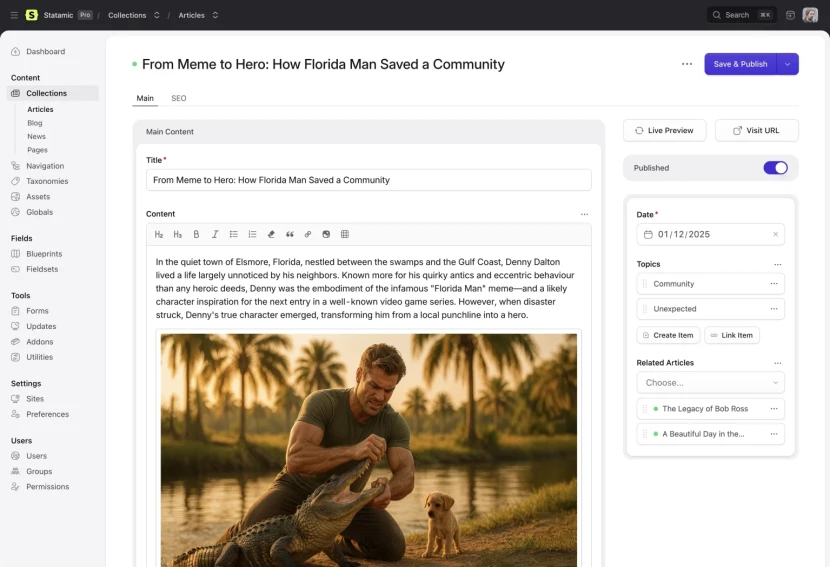
Statamic's control panel is clean and consistent. Collections, entries, global sets, assets. Once a team learns the structure, they can confidently update anything on the site without calling us.
As developers, we have much more control over how Statamic acts, and therefore we can customise it to be as simple or complex as the user needs.
Performance and hosting
WordPress is known for needing caching plugins, optimisation plugins, and often a dedicated managed host just to feel fast.
Statamic, especially when running on flat files or static, is quick out of the box. Because it sits on Laravel, hosting is flexible. You can deploy to a standard server or Laravel Cloud.
Google's Core Web Vitals are a ranking factor now, so performance isn't just a nice-to-have.
When WordPress is still the right call
WordPress isn't wrong for every project.
If you need a simple brochure site, you have a tiny budget, and your team already knows WordPress, it can be a pragmatic choice. The ecosystem is vast. Designers and developers are cheap and plentiful. Themes get you live quickly.
Where WordPress struggles is when the project becomes genuinely custom. A membership platform, a community platform, a video platform, a learning management system, a marketplace with payments and permissions. At that point you're fighting WordPress, not working with it.
That's where Statamic and the Laravel foundation underneath it shines.
What Statamic costs versus WordPress
WordPress core is free. Statamic has a licence fee for the Pro edition.
On paper, WordPress looks cheaper. In practice, once you add premium plugins (ACF Pro, Yoast Premium, WP Rocket, a security plugin, a forms plugin, a membership plugin), you're often spending more per year on WordPress licences than a one-off Statamic licence costs.
More importantly, our build and maintenance costs on Statamic projects tend to be lower over three years because we're not spending time wrestling plugin conflicts or patching emergency security updates.
The developer side of things
For the CTOs and tech leads reading this, here's the architectural piece.
Statamic gives you Laravel underneath.
That means Eloquent, queues, Blade, Livewire, and the entire Laravel ecosystem is available when you need custom functionality. You're not writing WordPress hooks and filters against a 20-year-old codebase. You're writing modern PHP in a framework your team will enjoy working in.
When a project starts as a content site and grows into a web application, Statamic doesn't hold you back.

Ready to start on your project?
We have been developing websites for over a decade. Our team of developers love what they do, and strive to ensure they leave the internet in a better place than they found it.
FAQ
Is Statamic better than WordPress for SEO?
Statamic sites tend to perform better out of the box on Core Web Vitals because they need fewer plugins and run leaner. Both can be optimised for SEO, but Statamic gives you clean markup, fast load times, and sensible defaults without needing extra optimisation plugins.
Can I migrate my WordPress site to Statamic?
Yes. We migrate WordPress sites to Statamic regularly. Content can be exported from WordPress and mapped into Statamic collections. URL structures can be preserved to protect SEO rankings, and redirects handled where URLs change.
Is Statamic harder to use than WordPress for content editors?
Most editors we've onboarded find Statamic easier than WordPress. The control panel is cleaner and more consistent. There are fewer surprises because the structure is defined by the developer rather than assembled from plugins.
How much does a Statamic licence cost?
Statamic Pro is a one-off licence fee per site. For most business projects the licence pays for itself compared to the annual cost of premium WordPress plugins.
Does Statamic work for e-commerce?
Statamic has Simple Commerce for lighter e-commerce, and it pairs well with Shopify or Stripe for more complex needs. For serious e-commerce we often recommend Shopify alongside a Statamic content site.
Is Statamic secure?
Statamic has a strong security record, partly because it relies on far fewer third-party extensions than WordPress. Fewer plugins means fewer attack surfaces. Running on Laravel also means security patches come through a well-maintained framework.
Can Statamic handle a high-traffic website?
Yes. Statamic can run as a static site or with aggressive caching, and it hosts happily on Laravel Cloud or Vapor for serverless scaling. Big names like Disney and Asana run on Statamic, which should give you confidence it holds up.
Thinking about a Statamic build?
If you're weighing up Statamic versus WordPress for your next project, we'd love to chat it through. No pitch, just a conversation about what fits your team and goals. Get in touch or request a quote.
More Articles

Laravel Cloud Managed Queues vs Queue Clusters (2026)
Laravel Cloud Managed Queues are now here. Why should you upgrade, and Cloud scales the work for you, so your team ships features instead.

Why change Laravel Agency
Steadfast Collective is a Laravel agency in the UK that designs, builds and scales web platforms for membership organisations, charities and brands.


Laravel Cloud Migration: What Teams Need to Know
Considering a Laravel Cloud migration? Understand the scenarios, risks and benefits before you move, with guidance from Steadfast Collective.